Posts

Old school campaigns and the assumption of time-richness

Sometimes you have an interesting exchange on Reddit that sets your mind working. I had such an exchange recently regarding the concept of being time-rich, and how classic editions of D&D, right back to OD&D itself, assume you have a lot of time on your hands - something that, in the modern world, is increasingly not the case. 🕷 A lot of things in the old systems only make sense when viewed from a certain point of view. Here, the point of view is that of a young wargamer in the mid-70s. You're fairly affluent, and your job doesn't impinge too much on your leisure time - apart from fantasy and sci-fi paperbacks, and the occasional late-night movie marathon, there aren't a lot of demands on your attention. This is the perfect environment within which to become obsessed with the brand new game of Dungeons & Dragons that someone just came up with. The old editions assume a similar environment for their players. OD&D in particular assumes that you'll have a ...
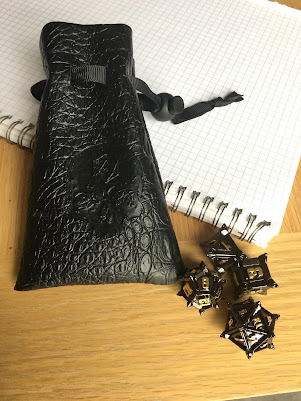
The Dice That Will Kill You

Image
A very short one today. I've been continuing with my open table sandbox in The Black Hack, and wanted to share my process for handling death and dismemberment when characters drop to 0hp, because I think it's been working really well at the table. I'll first explain the ritual very briefly, then explain why it works , and why I think it finds a good middle ground between the old and new schools. 🕷 First, allow me to introduce  The Dice That Will Kill You . The Dice That Will Kill You My brother bought me these as a Christmas present - they are cast in metal, and very heavy, like little angry sea mines. They have already scored and dented our dining-room table. Note the skull, barely visible, on the bag. The Dice That Will Kill You are what give the procedure its special ritual tone. These are the special dice that only come out when a character is near death. On such occasions, I hand their player the bag, and recite the exact words: "<Character name>, these ar...

Campaign structure and getting your hooks in

I think we think about adventures and hooks wrong. It struck me recently, when writing about illusionism , that we use hooks all the time in games where they really aren't warranted - we use hooks to disguise the buy in for a game in the narratively-focused style, trying to make it appear as a sandbox. Let me explain. A lot of narrative-focused campaigns (I even want to say "most") start with a quest hook: Someone comes up to you in a bar and gives you a quest, or bandits attack the town, or you get a message saying that the king is dying, would you mind awfully blah blah blah. By "narrative-focused", I mean campaigns where the GM has prepped a plot they want the PCs to follow - not a bad structure in and of itself, as I'll discuss. But these campaign openers annoy the hell out of me, because they're empty scenes: They look like they have some meaningful choice in them, namely the choice to take the quest or not, but there isn't actually a decision h...

Authentic Play and the Undiscovered

Image
Yikes, what a title. Save it for the book, am I right? This is quite a long one, as it takes on quite a few points and blog posts. But there are some insights here, both from others and, I hope, from me. 🕷 Authenticity The Glatisant rolled around again, and fed me a slew of new blog posts. Chasing them down the rabbit hole, I found a discussion of FKR and OSR methods of play that focused on the interesting concept of authenticity. The best way to define authenticity is probably in contrast to its opposite, illusionism. This concept, from Hack and Slash, is exemplified by a technique called  the quantum ogre : The players go left, they face an ogre encounter; the players go right, they face the same ogre encounter, because it's what the GM has prepared. Even if you haven't heard of it in those terms, you'll probably have played at a table where the technique was used. The idea is that the GM has crafted an experience for the players, here involving an ogre encounter, and t...

War Stories

Image
I've been having ideas left and right for stuff that I want to write about, and spilling out words onto the page, but in the tangle of offshoots and cul de sacs that follow, the bolder ideas have been getting lost in the murk. If you want to hear me ramble on at length about something very few people will really care about, you can read my doctoral thesis when it's done. So I've cut about 75% of this post (no really), to focus on what I want to talk about. What I want to talk about is war stories. You see, ttrpgs are all about stories - no duh. But there are two types of stories (at least in trad gaming) as I see it. I call these "narratives" and "war stories". A narrative is what you get when a GM sits down ahead of time and thinks up what action the coming session is going to contain. It consists of set-pieces, and connections between them. There are a few reasons people do their game prep in terms of narratives. One is ease: You generally have to do l...

Sandbox XP

Image
I've hit on an idea for how to run XP in a way that will work for my upcoming sandbox game using The Black Hack. The system itself should be pretty much transferrable to any classic D&D derivative that uses race-as-class (I've hacked the "kindred classes" from B/X into my game), or with some tweaks for ones that don't. The one complaint people consistently lodge against The Black Hack is that it doesn't contain much scope for levelling up. This confuses me slightly - as far as I can tell, it offers about as much scope as the early editions of D&D on which it's modelled. That is, fighter-types get better at hitting things, magic users (in the broad sense) get access to more powerful spells, thieves' skill at thief-y tasks increases, as does their backstab damage, and of course everyone gets more hp. Anyway, as I understand it, advancement in these games is largely supposed to be driven by acquisition, especially of magic items - your +2 to hit e...

The Imagined Game

Image
I've only just realised that's a punny title. It appears I can't help myself. I'm always trying to think of how to explain the OSR, especially to relatively inexperienced gamers, who are often the ones to rock up at my table. It's tricky for a number of reasons, not least of which are that it's largely defined in contrast to a playstyle these new players will have little or no experience with, and that the priorities of the OSR as a quote-unquote "movement" apparently keep shifting. But I think I've found a new way to describe it, the way I'm going to explain to people, from now on, why you'd play using an older ruleset, or even something completely different that's designed to evoke  an older ruleset. Do you remember hearing about ttrpgs for the first time? It's an experience I imagine you and I share, and share with a lot of people. I can't remember the actual event itself, but I definitely remember the experience - confusion ...